
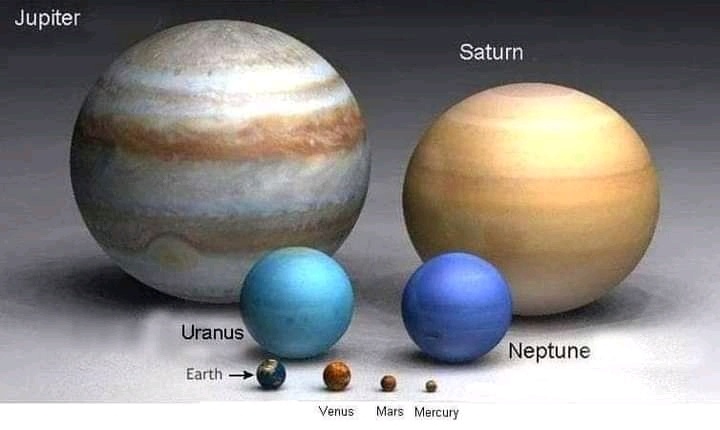
-The things that revolve round the Sun and the stars are called planets.
-Total 8 planets have been discovered in our solar system.
-Jupiter is the largest in our solar system and the smallest is mercury!
-NASA has claimed that the hottest planet is venus!
5-Uranus is the coldest planet in the planet!

The solar system is so big that no one has been able to know it properly till date.From these eight planets, only animals can live in the environment of the earth.NASA scientists say that people can live on Mars too and
Such NASA people have also claimed that aliens live in other planets too, but till date there is no proof, only hypothesis.Now-a-days
Elon musk has started Ready to Live on Mars and the work is underway.If people came to know that the earth is going to be destroyed, then they can go and live on Mars.
Some facts about planets.
1-Mercury
. Mercury is the smallest planet in the Solar System and closest to the Sun. • There is no atmosphere on this planet, so life is not possible here. • The day temperature on the planet Mercury is 427 ° C and the night temperature – 173 ° C. HPTET UPTET CTET TET SSC VYAPAM Spardha Kundra • It has no satellite. • It is visible in the morning and evening. This planet has the highest daily temperature difference of 600 ° C. The distance of the planet Mercury from the Sun is 57.91 million km and it takes 88 days to revolve around the Sun. Mercury is a rocky planet with a large amount of iron in its core. • The surface of this planet is quite different from the surface of other planets. And elements like sulfur and • chlorine are found in large quantities on the rocky surface here. • In view, this planet appears dark gray i.e. dark brown.
2-Venus
Venus is the second closest planet to the Sun in the Solar System. • This planet has no satellites. • The atmosphere of the planet Venus contains 90 to 95% Carbon dioxide gas. • It is the hottest and brightest planet. Its temperature remains around 462°C. • It is the closest planet to Earth. • It rotates from east to west unlike other planets • Venus is the second brightest object to shine at night after the Moon. The distance of this planet from the Sun is 108.2 million km. • It takes 225 days to orbit the Sun. • Venus orbits the Sun at an average speed of 1,26,077 KM/Hour.
3-Earth
The Earth comes third in the distance from the Sun and is also called the Blue Planet. Earth is the only planet where there is life. Earth has only one natural satellite which we know by name in Moon. Talking about the age of the earth, it is 4.543 billion years old. • Like all the planets, the Earth also revolves around the Sun. It takes 24 hours for the Earth to complete one revolution on its axis whereas it takes 365 days to complete one revolution around the Sun. The shape of the Earth is a Geoid. • Its axis polar diameter is 12715 KM and equatorial diameter is 12756 KM. 71% of the Earth’s surface is aquatic and 29% is terrestrial. That is, 71% of the earth is water and 29% is land in which we humans and other animals, animals, birds etc. live
4-Mars
. Mars is fourth from the Sun and it is the second smallest planet in the solar system. It is also called the Red Planet because its surface looks like rusted iron. • There is a huge volcano on Mars named Olympus Mons. • Mars is a dry and dusty planet, sometimes a huge dusty storm on this planet continues for months. • Mars can also be seen at night with mangi eyes. • The atmosphere on it is extremely viral. • It has two satellites, Deimos and Phobos, whereas we read above, the Earth has only one satellite, the moon Deimos is the smallest satellite in the solar system.
5-Jupiter
Jupiter means that the planet Jupiter is the fifth planet from the Sun and it is the largest planet in the solar system. • Its planet’s mass is 300 times more than that of the Earth. The diameter of the planet Jupiter is 1,40,000 Km, which is about 11 times the diameter of the Earth. Like the Sun, the majority of Jupiter is made up of Hydrogen and Helium, besides Ammonia, Methane and Water, but it is in very small quantities. • It has 63 satellites, of which Ganymede is the largest. • It has the properties of both a star and a planet because it has its own radio energy. • Its atmospheric pressure is 10 million times greater than that of the Sun.
6-Saturan
. Saturn is the sixth planet from the Sun and it is the second largest planet in the solar system after Jupiter (Jupiter). Its distance from the Sun is 1.434 billion km. • It is not a solid like Earth, but is made of gas. It is composed of 94% Hydrogen, 6% Helium and some parts Methene and Ammonia. • The diameter of the planet Saturn is 1,16,460KM. • There are 7 developed rings around its midline which collectively revolve around it due to gravity. • It is also called gas ball or galaxy like planet. • So far its 60 satellites have been detected. Titan is the largest satellite of Saturn. • Saturn is the last planet that can be seen with the naked eye.
7-Uranus
. Uranus is the seventh planet from the Sun and it is at a distance of 2.871 billion KM from the Sun. • It was discovered by William Harsil in 1781 AD. • Like Saturn, it also has rings whose total number is five. Their names are Alpha, Beta, Gamma, Delta and Epsilon. • It rotates clockwise on its axis. It is also called recumbent planet. • Gases like hydrogen, helium, methane and ammonia are also found on this planet. ₹ • All its satellites revolve in the opposite direction of the earth. • The temperature in the upper atmosphere of this planet is quite cold. Uranus appears blue in view because there is a lot of methane present in its atmosphere. • Its mass is about 14.5 times the mass of the Earth
8-Neptune
. Varuna is the eighth and farthest planet from the Sun. Its distance from the Sun is 4.495 billion KM. • Its mass is 17 times the mass of the Earth. • Neptune’s atmosphere is made up of about 80% hydrogen and 19% helium. Apart from this, small amounts of water and methane are also found in it. • This planet was discovered by German astronomer Johann Galle in 1946 AD. • It has 13 satellites, of which Tritan and Marid are prominent.
-Different rain on different worlds!
Earth – water
Venus – sulfuric acid
Titan – methane
Neptune – diamond
Hd 189733b – glass
Ogle-tr-56b – liquid iron
-Important space agency
America – NASA
India – ISRO
Russia – ROSCOSMOS
China – CNSA
Japan – JAXA
 deepak raidas knowledge.com